


How to Keep Your Brown Turkey Fig From Becoming a Literal Popsicle
The Legend of the Brown Turkey (and Why It’s Currently Shivering)
If you have a Brown Turkey fig tree, you’ve probably heard it’s the “indestructible” workhorse of the fig world. People talk about it like it’s a horticultural tank that can survive anything short of a direct meteorite strike. But here’s the cold, hard truth: even a tank can freeze up if you leave it in a blizzard without a plan. I’ve seen enough “dead” sticks in the ground come April to know that while the Brown Turkey is tough, it’s not magic. It’s a plant, not a penguin.
The goal today is simple: we are going to make sure your Brown Turkey survives the winter without becoming a literal popsicle. Whether you’ve got a massive specimen in the yard or a tiny cutting you’re babying in a pot, I’m going to walk you through the physics of not killing your plants when the mercury drops. We’re talking dormancy, insulation, hydration, and why your garage might just be the VIP lounge your tree is dreaming of. Grab a warm drink, and let’s get your trees tucked in.
Understanding the Brown Turkey’s Cold Hardiness
Before we start wrapping your tree in burlap like a leafy mummy, we need to understand what we’re dealing with. The Brown Turkey is generally rated for USDA Zones 7 through 9, though some brave souls push it into Zone 6 with varying degrees of success (and a lot of sweat). In the right conditions, a mature, dormant Brown Turkey can handle temperatures down to 10°F or even 5°F without losing its main structure.
However, “hardy” is a relative term. If your tree is young, its bark is thin and its root system is shallow. It’s basically a toddler in a t-shirt. Even an older tree can be caught off guard by a sudden “polar vortex” if it hasn’t had time to properly enter dormancy. When water inside the plant cells freezes, it expands, causing the cells to burst. This is the botanical equivalent of a pipe bursting in your basement, and it’s just as messy to fix. Our job is to prevent that cellular explosion by managing how the tree experiences the cold.
The Danger of the “False Spring”
The biggest threat to a Brown Turkey isn’t usually a steady, predictable cold. It’s the rollercoaster. If you get a warm week in February and your tree decides it’s time to wake up and push out new growth, and then a hard freeze hits three days later, you’re in trouble. Sap starts flowing, the tree loses its “antifreeze” properties, and that new growth will turn to mush faster than you can say “fig jam.” Protecting your tree is as much about keeping it cold and asleep as it is about keeping it from freezing.
Winterizing In-Ground Trees: The “Trash Can” and “Mummy” Methods
If your Brown Turkey is planted in the ground, you can’t exactly move it to the bahamas when the snow starts falling. You have to bring the protection to the tree. There are two main ways I like to do this, depending on the size of the plant and how much your neighbors already think you’ve lost your mind.
The Mulch Mountain (For Young Trees)
If your tree is still relatively small (under four feet), the “Mulch Mountain” is your best friend. Once the tree has dropped all its leaves and is fully dormant—and I mean fully, don’t rush this—you can prune it back slightly and drive a few stakes around it. Wrap some hardware cloth or chicken wire around the stakes to create a cage, then fill that cage with dry leaves or straw. Not hay—hay has seeds, and you don’t want a localized wheat field in your garden next year.
This insulation keeps the trunk at a steady temperature. In the spring, you just pull the cage away and spread the mulch. It’s like giving your tree a heavy down comforter. Just make sure the mulch isn’t soaking wet when you put it in, or you’re just creating a mold hotel.
The Burlap Mummy (For Established Trees)
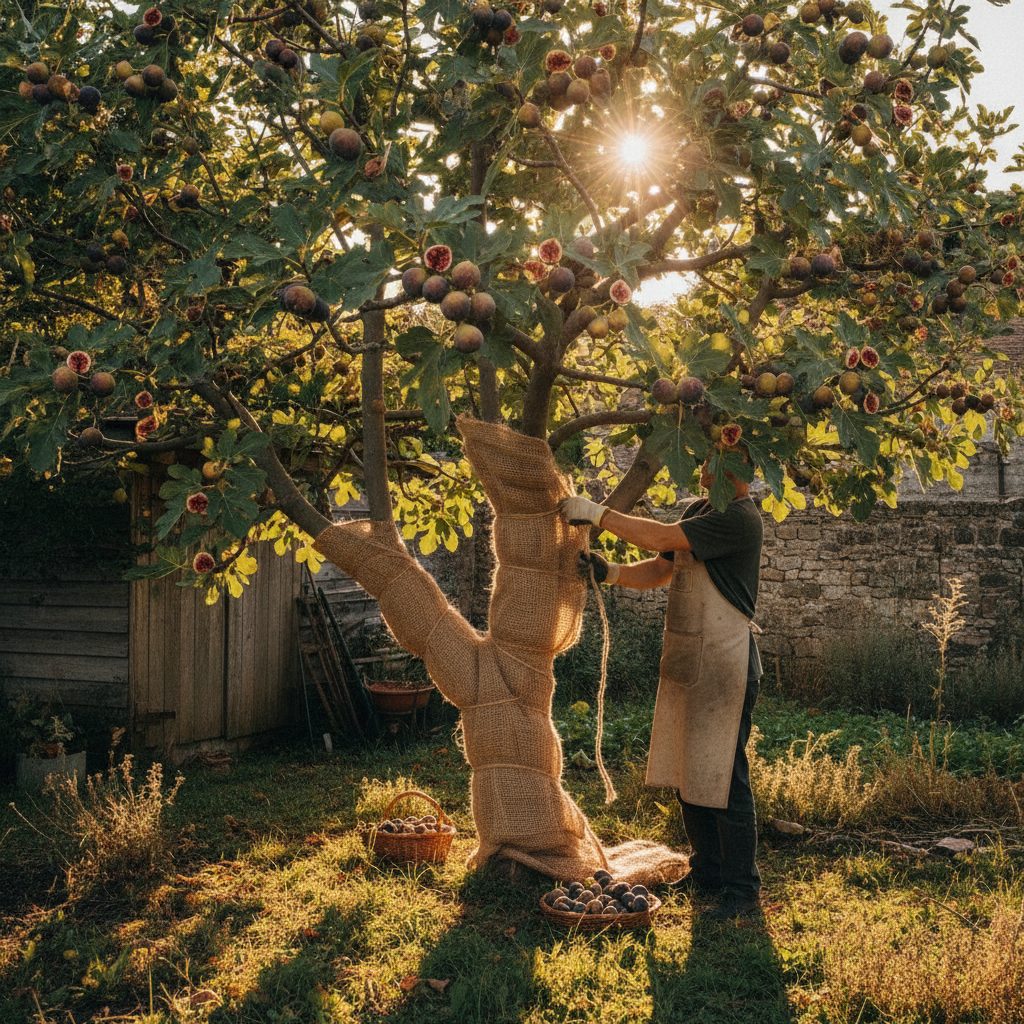
For larger trees, you’re going to need more supplies. You’ll want to gather the branches together and tie them loosely with twine. Don’t crank them down like you’re trying to win a wrestling match; just bring them in so the profile is narrower. Wrap the entire structure in several layers of burlap. Burlap is great because it breathes. Plastic is the enemy here; if you wrap a tree in plastic, the sun will hit it, turn it into a greenhouse during the day, and then it will freeze even harder at night. That’s a recipe for “cooked and then frozen” wood, which is not a flavor profile we’re looking for.
Top the whole thing off with a waterproof cap, like a bucket or a piece of tarp tied over the top only, to keep snow from sitting in the center of the bundle. Think of it as a nice winter coat with a rain hat.
The Container Struggle: Pots are Different
If your Brown Turkey is in a container, you have a massive advantage: mobility. But you also have a massive disadvantage: the roots are exposed. In the ground, the earth acts as a massive thermal heat sink. In a pot, your roots are separated from the freezing air by maybe an inch of plastic or terracotta. Roots are much more sensitive to cold than the branches above ground. If the root ball freezes solid for an extended period, that’s game over.
The Garage Retreat
The best place for a potted Brown Turkey is an unheated garage, shed, or basement that stays between 35°F and 45°F. You want it cold enough that the tree stays asleep, but warm enough that the pot doesn’t turn into a block of ice. Once the leaves fall off, drag it inside. It doesn’t need light while it’s dormant. It just needs to be ignored, which is a skill many of us need to practice anyway.
Don’t put it in a heated living room. If you bring a fig tree into a 70°F house, it’s going to think it’s July. It will start growing weak, leggy branches that will be magnets for spider mites. Keep it in the dark, keep it cold, and let it rest.
Watering During Dormancy
This is where most people mess up. Just because the tree is asleep doesn’t mean it’s dead. It still needs a tiny bit of moisture so the roots don’t desiccate. Check your potted figs once a month. If the soil is bone-dry an inch down, give it a small drink. We aren’t looking for a deep soak; we’re just making sure the root system doesn’t turn into dust. If the soil is still damp, leave it alone. Overwatering a dormant tree is the fastest way to invite root rot, and nobody wants to start spring with a soggy, rotten mess.
The Cutting Edge: Protecting Your Propagation Success
If you’re like me, you probably have a dozen Brown Turkey cuttings you’re trying to root over the winter. These are the most vulnerable members of your fig family. A cutting has no established root mass to protect it, so it relies entirely on you to play God.
If you’re rooting in cups or bins, keep them indoors in a controlled environment. If you’re using the “direct stick” method outside, you better have a plan for a cloche or a cold frame. For most beginners, I recommend rooting indoors where you can monitor the temperature and humidity. A cutting that gets hit with a hard freeze before it has established roots is basically just a very short, very disappointing popsicle stick.
Common Winterizing Mistakes to Avoid
I’ve made all of these, so don’t feel bad if you have too. Experience is just the name we give to our gardening scars.
- Pruning too late: If you prune in late autumn while the tree is still active, you might stimulate new growth right before the freeze. Wait until the tree is fully dormant and all leaves have dropped.
- Fertilizing in the fall: Stop fertilizing by late summer. You want the tree to slow down and harden off, not start a new growth spurt with a belly full of nitrogen.
- Using the wrong wrap: I’ll say it again: avoid plastic wraps that touch the wood. They trap moisture and heat, creating a fungus-friendly sauna during the day and a freezer at night.
- Forgetting the “Heel In”: If you have potted figs and no garage, don’t just leave them on the patio. Dig a trench and bury the pot in the ground, or group them all together and pile mulch around the sides of the pots. Strength in numbers, people.
The “Wait and See” Game: Spring Triage
When spring finally rolls around, don’t panic if your Brown Turkey doesn’t leaf out the same day as the dandelions. Figs are notorious for sleeping in. They are the teenagers of the garden; they will stay in bed until it’s undeniably warm.
To check if your tree survived, use the “Scratch Test.” Take your fingernail or a small knife and lightly scratch a tiny bit of bark on a branch. If it’s green and moist underneath, the branch is alive. If it’s brown and brittle, that part is dead. If the top of the tree died back but the roots were protected, the tree will often send up new shoots from the base. This is the beauty of the Brown Turkey—it’s a survivor. Even if the “popsicle” happened above ground, the “roots” might still be ready to party.
What to Do With Winter Die-back
If you find dead wood in the spring, wait until the tree starts pushing new growth before you prune. This lets the tree show you exactly where the “live” line is. Prune back to about a quarter-inch above a healthy, green bud. Your tree might look a little shorter this year, but it will grow back with a vengeance. Figs grow incredibly fast once they get going.
Why It’s All Worth It
You might be thinking, “Figgy, this sounds like a lot of work for a fruit that I can buy at the store.” First of all, store-bought figs are a pale, sad imitation of a tree-ripened Brown Turkey. A home-grown fig, warm from the sun, with that honey-like interior? That’s worth a little bit of burlap-wrapping and garage-dragging.
Secondly, there is a profound satisfaction in seeing a tree wake up after a brutal winter because you helped it through. It makes you part of the process. You aren’t just a consumer; you’re a steward. Plus, the more you learn about protecting your “common” varieties like the Brown Turkey, the more confident you’ll feel when you eventually succumb to the urge to buy those rare, expensive varieties that I know you’re already looking at.
Ready to Level Up Your Fig Game?
Winterizing is just one part of the journey. To truly succeed, you need the right tools, the right knowledge, and occasionally, a few more trees to keep your current ones company. Whether you need sharp pruners that won’t crush your stems, or you’re looking for your next favorite variety to add to your collection, we’ve got you covered. Don’t let your garden goals freeze over—get what you need to keep growing all year long.