

Chop Your Brown Turkey Like Its Hot for a Radical Winter Haircut
Why Your Brown Turkey Fig Needs a Radical Winter Makeover
If you have a Brown Turkey fig tree, you probably know it’s the golden retriever of the fruit world. It’s loyal, it’s hardy, and it produces a staggering amount of fruit even when you forget its birthday. But here’s the thing: left to its own devices, a Brown Turkey will eventually turn into a tangled, chaotic mess that looks less like a fruit tree and more like a prop from a low-budget horror movie set in a haunted forest.
Winter is the time to step in and play stylist. We aren’t just cutting branches for the sake of making a mess; we are directing traffic. Pruning is how we tell the tree, “Hey, stop putting all your energy into reaching for the power lines and start putting it into those delicious, honey-sweet figs I like to eat.” If you’ve been staring at your dormant tree with a pair of rusty shears and a sense of impending doom, take a deep breath. We are going to chop it like it’s hot, and your tree is going to love you for it.
The Magic of Dormancy: Timing is Everything
You wouldn’t perform surgery on a marathon runner while they’re mid-sprint, and you shouldn’t hack away at your fig tree while it’s actively pushing out leaves and fruit. The best time to give your Brown Turkey a radical haircut is during deep dormancy—usually late winter or very early spring, before the buds start to swell and think about turning green.
When the tree is dormant, the sap has retreated to the roots. Cutting it now minimizes stress and prevents the “bleeding” of white latex sap that can happen in the spring. Plus, with the leaves gone, you can actually see what you’re doing. It’s much easier to spot a crossing branch when it isn’t hiding behind a fan of foliage. Think of it as an X-ray view of your tree’s skeletal structure. We want a strong frame, not a bird’s nest.
Equipping Yourself for Success
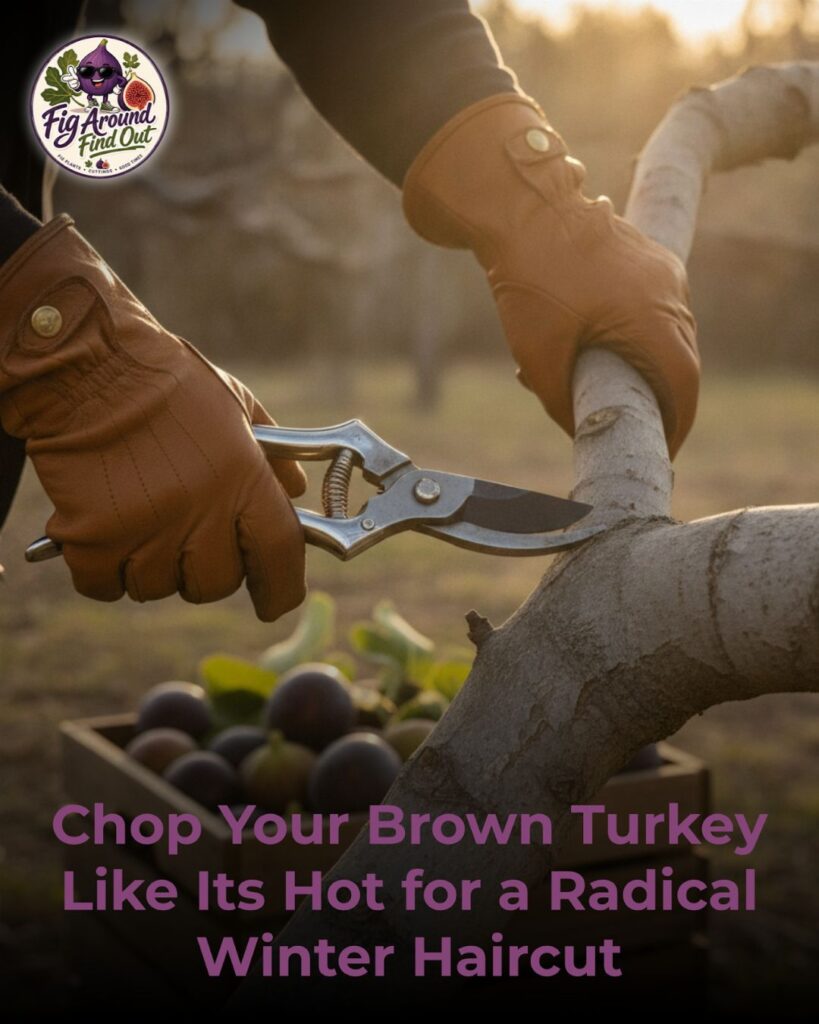
Before we make the first cut, let’s talk about tools. You don’t need a specialized degree, but you do need sharp equipment. Dull pruners don’t cut; they crush. Crushed branches are an open invitation for pests and disease to move in and set up shop.
- Bypass Pruners: These work like scissors and are perfect for smaller branches. Clean them with rubbing alcohol before you start so you aren’t spreading last year’s problems to this year’s growth.
- Loppers: For the branches that are too thick for your hand pruners. If you’re straining your wrist, it’s time to level up to the loppers.
- Pruning Saw: If your Brown Turkey has been ignored for a few years, you might need a small folding saw for those “oops, I let that grow too big” limbs.
- Gloves: Fig sap isn’t toxic, but it is irritating to the skin for many people. It’s sticky, it’s itchy, and it’s generally better left on the tree than on your forearms.
Step 1: The Three D’s (Dead, Damaged, and Diseased)
Every pruning session should start with the easy wins. Look for the Three D’s. Dead wood is brittle and usually gray or black; it’s not doing anything for the tree’s future. Damaged branches might be cracked from wind or weighted down by last season’s harvest. Diseased wood often has strange discolorations or cankers.
Removing these is like clearing the clutter off your kitchen counter before you start cooking. It gives you a clear view of the “living” parts of the tree. When you remove a dead branch, cut it back to the “collar”—that slightly swollen area where the branch meets the main trunk. Don’t leave a stub, but don’t flush-cut it into the trunk either. The collar is where the healing magic happens.
Step 2: Managing the Sucker Situation
Brown Turkey figs are notorious for sending up “suckers” from the base of the tree. These are long, whip-like shoots that grow straight up from the ground or the very bottom of the trunk. While it’s tempting to think, “Hey, more branches means more figs,” the reality is the opposite.
Suckers are the ultimate energy vampires. They suck nutrients away from the main structure of the tree and rarely produce quality fruit. If you want a single-trunk tree (standard) or a clean multi-trunk bush, you need to clear these out. Cut them off as close to the ground as possible. If you’re feeling adventurous, these suckers are actually great for propagation, but on the main tree, they’ve got to go.
Step 3: Opening Up the Center
Imagine your fig tree is a solar panel. Sunlight needs to hit as much of the interior as possible to ripen the fruit and keep the wood healthy. If the center of your tree is a dense thicket of branches, the figs in the middle will stay green, hard, and sad.
Look for branches that are growing toward the center of the tree rather than outward. We want an “open vase” shape. Also, look for “crossing” branches—limbs that are rubbing against each other. When branches rub, they create wounds. Those wounds become entry points for beetles and fungi. Choose the stronger, better-positioned branch to keep and remove the other one. Airflow is your best friend in preventing fruit rot and keeping your tree happy during a humid summer.
Step 4: The Radical Chop (Heading Back)
Now we get to the “Chop It Like It’s Hot” part. Brown Turkeys are vigorous growers. If you don’t head them back, they will eventually grow so tall that the only way to harvest the fruit is with a ladder and a prayer.
To keep the fruit within reach, you can prune back the previous year’s growth by about one-third to one-half. Look for a “bud” (a little bump on the branch) that is facing away from the center of the tree. Make your cut about a quarter-inch above that bud at a slight angle. This encourages the tree to grow outward rather than straight up. This radical haircut stimulates new growth, and since Brown Turkeys fruit on new wood (the “main crop”), you’re essentially laying the groundwork for a massive harvest.
Climate Considerations: Hard Pruning vs. Light Pruning
Your strategy might change slightly depending on where you live. If you’re in a warm climate (Zone 8 or higher), you can be pretty aggressive. Your Brown Turkey will bounce back faster than a toddler after a nap. You can prune heavily to maintain a specific size and shape without much worry.
If you are in a colder climate (Zone 6 or 7), you might want to be a bit more conservative. Sometimes, extreme winter cold will “tip kill” the branches anyway. In these regions, many growers wait until they see which buds are actually waking up in the spring before making their final major cuts. However, removing the bulk of the messy growth in late winter still helps the tree focus its energy once the ground thaws.
The “Oops” Factor: Don’t Panic
One of the biggest fears beginners have is that they’ll “kill” the tree by over-pruning. Let me put your mind at ease: it is very difficult to kill a healthy Brown Turkey with a pair of pruners. Even if you get a little carried away and the tree looks a bit naked, it will almost certainly grow back.
I’ve seen people accidentally back their trucks over fig trees, only to have the tree send up five new trunks by July. Think of pruning as a conversation. You’re asking the tree to change its shape. If it doesn’t look perfect this year, wait until next winter and try again. Horticulture is just a series of experiments where the subjects occasionally provide snacks.
What to Do with the “Chop”
Once you’re finished, you’ll likely have a pile of branches on the ground. Don’t just throw them in the green waste bin! These are potential new trees. Brown Turkey figs are incredibly easy to root from dormant hardwood cuttings.
Take some of those healthy, pencil-thick branches you just cut, trim them into 6-to-8-inch lengths, and stick them in a pot of well-draining soil (or even just a glass of water if you’re lazy like me). Before you know it, you’ll have ten more trees to give to neighbors, friends, or that person at the post office who looked like they needed a hobby. This is how the “fig obsession” starts. You’ve been warned.
Common Pruning Mistakes to Avoid
- The “Flat Top”: Don’t just shear the top of the tree like a hedge. This creates a “witch’s broom” of weak, thin growth at the top that shades out the rest of the tree. Make individual cuts at different heights to maintain a natural shape.
- Using Dirty Tools: I mentioned it before, but it bears repeating. A dirty blade is a vector for disease. Give them a quick wipe with alcohol between trees.
- Pruning Too Late: If the tree has already leafed out, you can still prune, but you’ll lose the energy the tree just spent pushing those leaves out. Try to get it done while the tree is still “sleeping.”
- Fear of the Cut: Being too timid won’t help the tree. If a branch needs to go, let it go. Your tree wants to be productive, not crowded.
Summary: A Happy Tree is a Pruned Tree
Pruning your Brown Turkey fig isn’t about perfection; it’s about health and accessibility. By removing the dead wood, thinning out the middle, and heading back the tall growth, you are ensuring that your tree stays manageable and produces the highest quality fruit possible. You’re giving the roots a chance to support a strong, well-ventilated structure rather than a wild thicket.
So, grab your shears, channel your inner stylist, and give that tree the radical winter haircut it deserves. It might look a little sparse for a few weeks, but come summer, when you’re standing under a canopy of lush green leaves reaching for a perfectly ripe fig, you’ll be glad you took the plunge. Gardening is all about trying, learning, and occasionally making a mess—and the Brown Turkey is the perfect partner for that journey.
Now that you’ve mastered the art of the winter chop, you might find yourself with some extra space in the garden—or perhaps you realized your old pruners aren’t quite up to the task. Whether you’re looking for new varieties to add to your collection or the best gear to keep your orchard thriving, we’ve got you covered. Get out there, keep those blades sharp, and remember: if you didn’t make at least one mistake, you weren’t really gardening.