

Is Your Brown Turkey Fig Ripe or Just Rude Learn the Art of the Squish
The Great Brown Turkey Betrayal
We have all been there. You walk out to your garden, eyes narrowed, staring at that Brown Turkey fig tree like it owes you money. It looks ripe. It’s brownish-purple. It’s hanging there with all the confidence of a fruit that is ready to change your life. You pluck it, take a massive bite, and—disaster. It’s dry, it’s mealy, and it tastes like a slightly sweet piece of cardboard. You’ve been bamboozled by a fruit.
The Brown Turkey is the most famous fig in the world, and also the most misunderstood. It’s the “gateway fig” for most gardeners, but it has a nasty habit of looking delicious weeks before it actually is. If you’ve ever felt like your tree is gaslighting you, don’t worry. I’ve grown dozens of these things, and I’ve eaten enough “liar figs” to know the difference between a fruit that’s ready and one that’s just putting on a show. Today, we are going to master the “Art of the Squish” and turn you into a Brown Turkey whisperer.
Why the Brown Turkey is the “Problem Child” of the Fig World
Before we get into the mechanics of the harvest, we need to understand the patient. The Brown Turkey is a workhorse. It’s hardy, it’s productive, and it’s about as easy to grow as a weed in a sidewalk crack. But because it’s such a vigorous grower, it’s often in a rush. It changes color early—sometimes ten days before it’s actually ripe. This leads to what I call “Premature Plucking Syndrome,” a tragic condition that affects thousands of well-meaning gardeners every summer.
Unlike a tomato or a peach, a fig will not continue to ripen once you pull it off the tree. It doesn’t care about your feelings or your countertop fruit bowl. Once that stem snaps, the sugar development stops dead in its tracks. If you pick it when it’s “pretty,” you’re missing out on the honey-like nectar that makes a real Brown Turkey worth the garden space. We aren’t looking for pretty; we are looking for ugly-delicious.
The Three Pillars of Ripe: Color, Droop, and Squish
Identifying a ripe fig requires you to use all your senses, except maybe hearing—unless your figs are talking to you, in which case we might need to discuss your fertilizer mix. To master the Brown Turkey, you need to look for three specific indicators. If only one of these is present, leave it alone. If all three are present, you have a winner.
1. The Transition of Color
A Brown Turkey starts out green and hard as a marble. As it matures, it turns a dusty bronze, then a deep brownish-purple. However, the real sign of ripeness isn’t just the color change; it’s the loss of the “sheen.” A young fig has a matte or slightly glossy look that feels tight. A truly ripe fig starts to look a bit dull, maybe even slightly dusty or shriveled. If it looks like it’s been through a long day at the office and just wants to take its shoes off, it’s getting close.
2. The “Neck Droop” Protocol
This is the most visual cue you’ll get. An unripe fig stands out horizontally from the branch, or even points slightly upward, defiant and stubborn. As the sugars develop and the cells inside the fruit break down into delicious goo, the fig becomes heavy. The “neck” (the part where the fruit meets the stem) will weaken and bend. When the fig is hanging vertically, looking down at the ground in shame, it is telling you it’s ready to surrender. This is the “hang time” that separates the amateurs from the experts.
3. The Art of the Squish
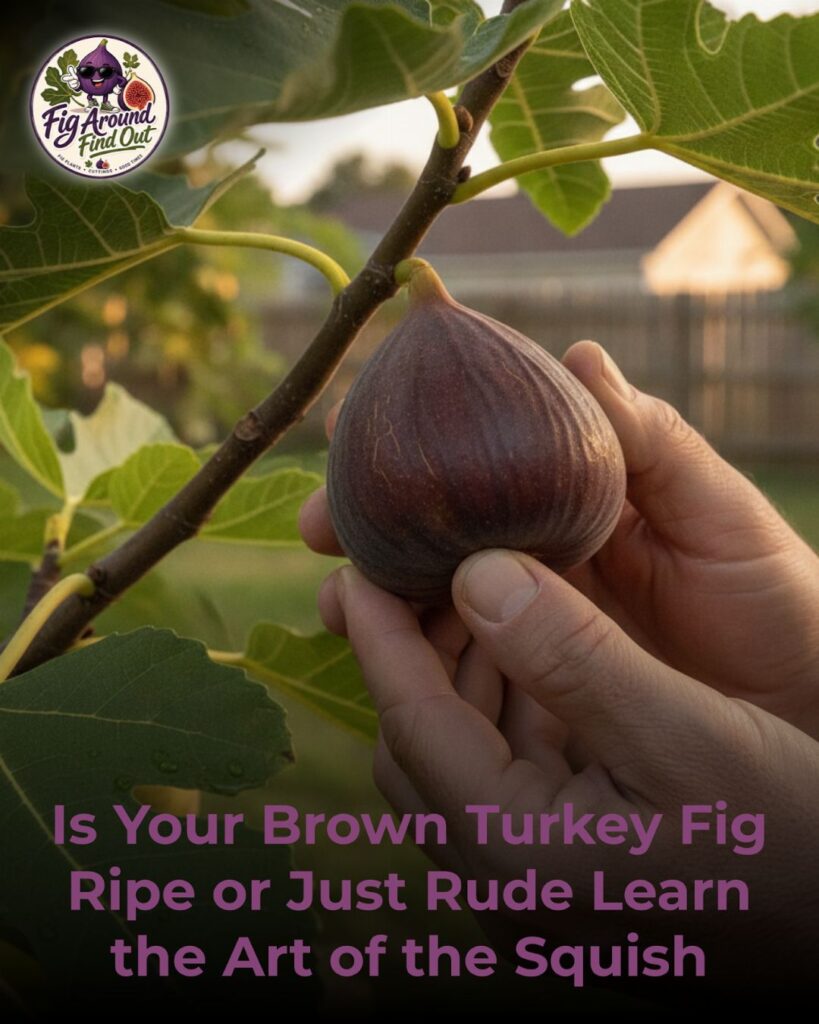
This is the most important skill in your repertoire. Forget everything your mother told you about not bruising the produce. To know a Brown Turkey, you must gently—gently—squeeze it. An unripe fig feels like a rubber ball. A semi-ripe fig feels like a firm marshmallow. A perfectly ripe Brown Turkey should feel like a water balloon that is just about to give up on life. It should be soft, yielding, and almost “mushy” to the touch. If you feel resistance, walk away. Come back in twenty-four hours.
Advanced Indicators: The “Honey Tear” and Skin Cracks
If you want to be a true fig snob (and I highly recommend it), look for the “Honey Tear.” Sometimes, when a Brown Turkey is at its absolute peak, a tiny droplet of clear, sugary nectar will form at the “ostiole”—that’s the little hole at the bottom of the fig. This is essentially the tree crying tears of joy because it did its job so well. If you see the tear, eat that fig immediately. Do not share it. You earned this.
You might also notice “sugar cracks” on the skin. These are vertical or horizontal tears in the skin that happen when the fruit grows so fast and fills with so much sugar that the skin literally can’t hold it all in. In the supermarket world, these are “damaged goods.” In the real world, these are the marks of a champion. A cracked fig is a sweet fig.
Common Mistakes: Don’t Be That Gardener
Even with the best intentions, things go wrong. Here are a few ways people mess up their Brown Turkey experience:
- The “Early Bird” Trap: You see the birds eyeing your figs, so you panic and pick them all while they’re still firm. Congratulations, you now have a basket of mediocre fruit. Get some bird netting or organza bags instead. Don’t let a blue jay dictate your harvest schedule.
- The Sap Trap: If you snap a fig off and white, milky sap leaks from the stem, you’ve made a mistake. That sap is latex, and it’s the tree’s way of saying, “I wasn’t finished!” It’s also an irritant that can make your mouth itch. A perfectly ripe fig should have almost no sap at the break point.
- Watering Woes: If you give your tree a massive drink of water right before harvest, the figs will swell up, lose their flavor, and likely split and sour. Dial back the watering slightly as the fruits reach peak ripeness to concentrate those sugars.
The Brown Turkey Personality: Climate and Soil Matters
It’s important to remember that your Brown Turkey might act differently than mine. If you live in a humid environment like the Southeast, your figs might struggle with “souring” if you leave them on the tree too long. The ostiole on a Brown Turkey is relatively open, which is basically an “Open for Business” sign for ants and fruit flies. In humid climates, you might have to pick them a hair earlier than someone in a dry climate like California or Arizona just to beat the rot.
Soil also plays a role. Figs are not heavy feeders, but if your soil is completely devoid of nutrients, the fruit will be small and dry. I like to top-dress with some compost in the spring and maybe a bit of slow-release fertilizer. Just don’t go overboard with nitrogen, or you’ll end up with a beautiful, giant green tree with zero fruit. We want figs, not a privacy hedge.
What to Do with a “Rude” Fig
So, you messed up. You picked a handful of Brown Turkeys that are just “okay.” Don’t throw them at the neighbor’s cat. While they won’t get sweeter on the counter, you can still save them through the magic of heat. Roast them with a little honey and balsamic vinegar, or slice them up and put them on a pizza with some goat cheese. Heat breaks down the fibers and concentrates what little sugar is there. It’s the “Participation Trophy” of the culinary world, but it works.
The Maintenance Side: Keeping the Harvest Coming
To get the best fruit, you need a healthy tree. Brown Turkeys are incredibly resilient, but they appreciate a little TLC. Make sure you are pruning in the dormant season. I like to remove about a third of the old wood every year to encourage new growth, as figs fruit on new wood (and the previous year’s wood for the breba crop). Think of it as giving the tree a haircut so it can focus on its career as a fruit producer.
And let’s talk about “The One More Plant” syndrome. If you find yourself obsessed with the Brown Turkey, it’s only a matter of time before you start looking at Celeste, Chicago Hardy, or Black Mission. It starts with one tree, and before you know it, you’ve converted your entire driveway into a container orchard. Embrace it. There are worse hobbies. At least this one results in snacks.
Your Homework: The Squish Test
This week, I want you to go out to your tree. Find a fig that looks ready. Now, leave it there. Wait two more days. Watch it droop. Watch the color go from “vibrant” to “exhausted.” Then, perform the squish. When you feel that incredible, soft give under your thumb, you’ll know you’ve reached the promised land. Growing figs is a lesson in patience, and the Brown Turkey is the ultimate teacher.
Remember, every mistake is just “horticultural tuition.” If you pick a bad one today, you’ll know better tomorrow. The tree isn’t being rude on purpose; it’s just waiting for you to learn its language. Once you speak “Fig,” you’ll never settle for a grocery store imposter ever again.
Ready to Expand Your Orchard?
Now that you’ve mastered the Art of the Squish with the Brown Turkey, you’re probably realizing that your backyard has room for a few more varieties. Maybe a honey-flavored yellow fig? Or a deep, jammy berry-flavored variety? One tree is a hobby, but three trees is a collection, and twenty trees is a lifestyle. I’ve spent years trial-and-erroring my way through the best varieties so you don’t have to. If you’re ready to stop guessing and start growing the good stuff, come see what we’ve got ready for your garden.