

How To Save Your Brown Turkey Fig From Becoming A Sad Stick Of Ice
So, You’ve Inherited a Frozen Twig: Saving the Brown Turkey Fig
We’ve all been there. You bought a Brown Turkey fig because the tag promised it was “hardy,” “prolific,” and “virtually indestructible.” Then February happened. Now, instead of a lush Mediterranean dream, you’re staring at a gray, brittle stick in the backyard that looks less like a fruit tree and more like a very sad lightning rod. You’re wondering if it’s dead, if you’re a failure as a plant parent, or if you should just bury it and pretend you’re into rock gardening now.
First of all, take a breath. The Brown Turkey is the resilient workhorse of the fig world. It has survived more neglect, polar vortexes, and questionable pruning decisions than almost any other variety. My goal today is to help you determine if your fig is actually pining for the fjords or just taking a very deep nap, and how to turn that sad stick of ice back into a fruit-bearing powerhouse. We are going to talk about the “Scratch Test,” the magic of dormant cuttings, and how to stop treating your tree like it’s made of glass.
Is It Dead or Just Drama? The Scratch Test
Before we panic and start shopping for a replacement (though “just one more tree” is always a valid life choice), we need to check for a pulse. Figs are notorious for being late sleepers. While your peach trees and hydrangeas are waking up and stretching, the Brown Turkey might still be under the covers with the blinds drawn. This often leads gardeners to assume the worst.
To see if there’s life inside that frozen stick, use your thumbnail or a small knife to gently scratch a tiny sliver of the bark away on a branch. You’re looking for the cambium layer. If it’s bright green and moist, congratulations! Your tree is alive and well; it’s just ignoring your texts. If it’s brown, dry, and brittle, that specific branch is toast. Work your way down the tree toward the main trunk. Often, the tips of the branches freeze off, but the core of the plant is still kicking. If you find green near the base, the “Sad Stick of Ice” is actually a “Subterranean Survivor” waiting for the right moment to explode back into growth.
The Brown Turkey Personality Profile
Why do we care so much about the Brown Turkey specifically? Because it’s the gateway fig. It’s a variety that produces two crops—a “breba” crop on last year’s wood and a “main” crop on the new growth. It’s famously adaptable, but it has a specific weakness: it’s a bit of a gambler. In warmer climates, it grows like a weed. In colder climates (Zone 7 and lower), it can die back to the ground if the temperature drops too low for too long.
The good news is that Brown Turkeys have an incredible root system. Even if the top of the tree looks like a discarded popsicle stick, those roots are often perfectly fine. They are essentially the bunkers of the plant world. If the top dies, the roots will send up new “suckers” or shoots in the spring. You haven’t lost the tree; you’ve just been forced into an unplanned “reboot” of its structure.
Step 1: The Tactical Haircut (Pruning for Life)
If you’ve done your scratch test and found a lot of brown, it’s time to get surgical. Pruning isn’t just about aesthetics; it’s about hygiene. Dead wood is an open invitation for pests and fungi to move in and start a commune. You want to remove anything that is truly dead, cutting back until you see that beautiful, vibrant green cambium again.
When you prune, make your cuts at a 45-degree angle about a quarter-inch above a node (those little bumps where leaves or branches sprout). This helps water run off the cut rather than sitting there and causing rot. If your tree died back to the ground, don’t lose heart. Cut the dead trunks down to the soil line. Within a few weeks of consistent warm weather, you’ll see little green ears poking out of the dirt. That’s your tree saying, “I’m back, did you miss me?”
Step 2: Propagation—Turning Tragedy into an Army
One of the best ways to “save” a Brown Turkey is to realize that one tree is a tragedy, but ten trees is an orchard. If you have any branches that are still alive but maybe in the way, or if you’re pruning back healthy wood to shape the tree, do not throw those sticks away. Those are potential children.
Brown Turkey cuttings are some of the easiest to root. I call it “horticultural tuition.” If you fail, it only cost you a stick. If you succeed, you have free gifts for the neighbors you actually like. Here is the quick-and-dirty method for rooting a cutting:
- Select your wood: Look for a piece of last year’s growth about the thickness of a Sharpie. It should be 6 to 9 inches long with at least 3 or 4 nodes.
- Prepare the base: Make a fresh cut just below the bottom node. You can lightly scrape the bark on the bottom inch to expose the green—this is where the roots will call home.
- The Medium: Use a well-draining mix. Think 50% potting soil and 50% perlite. Fig roots enjoy a drink, but they do not need swimming lessons. If the soil is a swamp, the cutting will rot before it realizes it’s supposed to grow.
- The Wait: Keep the cutting in a warm spot with bright, indirect light. Don’t tug on it every day to see if roots are growing. I know it’s tempting, but you’re literally ripping off the microscopic baby roots every time you do that. Patience is a virtue; I don’t have it, but I pretend to for the sake of my figs.
Step 3: Hydration and Nutrition (The “Tough Love” Phase)
Once your Brown Turkey starts showing signs of life—whether it’s new leaves on old branches or new shoots from the ground—it’s going to be hungry. However, do not overwhelm a stressed tree with heavy synthetic fertilizers immediately. That’s like offering a marathon runner a five-course steak dinner the second they cross the finish line. They’re going to regret it, and so will you.
Start with a balanced, slow-release organic fertilizer or a nice layer of compost. This provides a steady stream of nutrients without burning the sensitive new roots. As for watering, consistency is key. Figs have large leaves that act like solar panels, but also like giant evaporative cooling systems. They lose a lot of water. If the soil gets bone-dry, the tree will get stressed and drop its fruit to save itself. Keep the soil “moist like a wrung-out sponge.”
Common Mistakes: What Not to Do
I’ve made every mistake in the book so you don’t have to. Here are the things that will turn your recovery project into a funeral:
- The Plastic Wrap Trap: Don’t wrap a struggling tree in clear plastic during the day in hopes of keeping it warm. You aren’t making a greenhouse; you’re making a sous-vide fig. The sun will cook the plant under that plastic.
- The Fertilizer Frenzy: More is not better. If your tree isn’t growing, adding more nitrogen won’t force it to. It will just salt the soil and hurt the roots. Wait for signs of growth before feeding.
- Giving Up Too Soon: I have seen figs wait until June to wake up. If the wood is still flexible and the scratch test is green, leave it alone. It’s just hibernating.
- Neglecting Mulch: Mulch is the unsung hero of the fig world. A thick layer of wood chips or straw protects the roots from temperature swings and keeps moisture in. It’s a blanket for the roots. Give them the blanket.
Winter Proofing for the Future
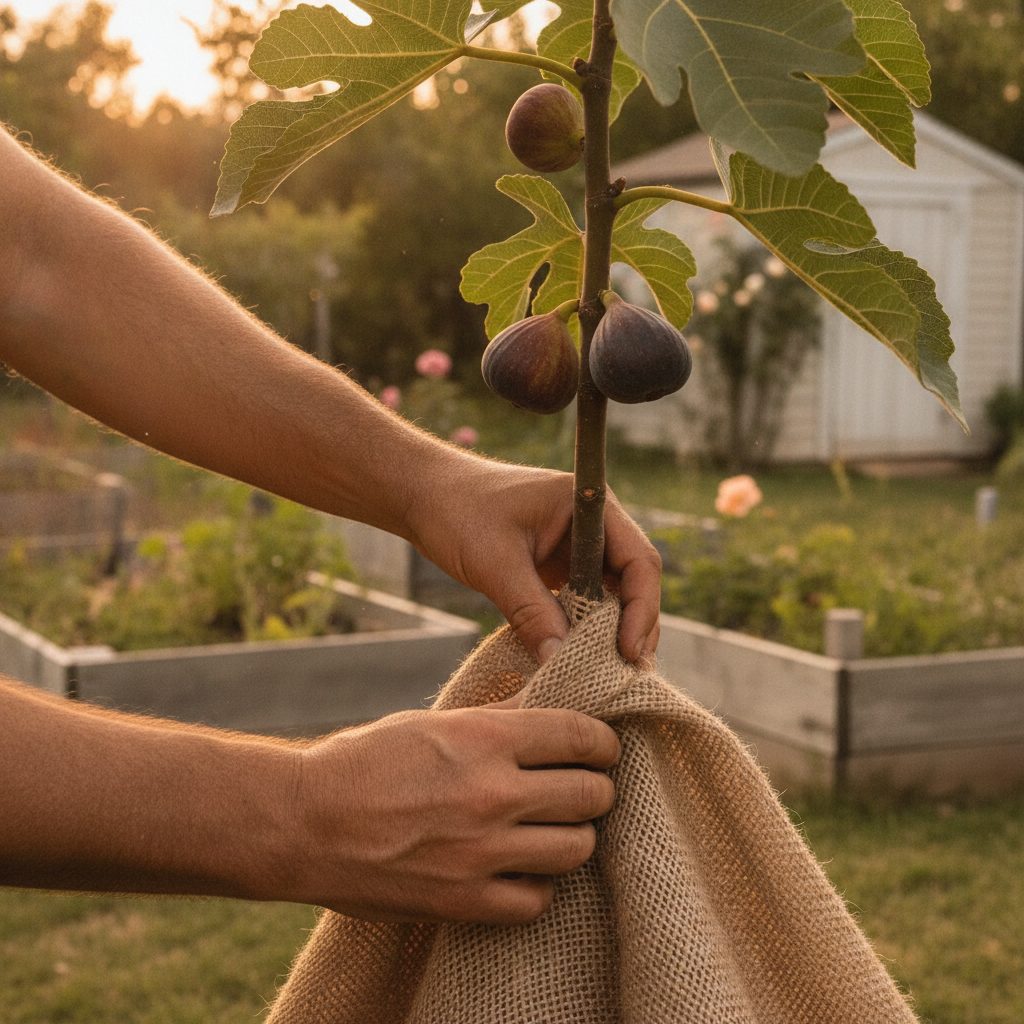
If you want to avoid the “Sad Stick of Ice” scenario next year, you need a plan. If you’re in a cold climate, consider “winterizing” your Brown Turkey once it drops its leaves and goes dormant. You can wrap the tree in burlap filled with straw, or if it’s small enough, build a temporary cage around it and fill it with dried leaves.
Alternatively, many people grow their Brown Turkeys in large containers. When the frost hits, you just dolly that bad boy into an unheated garage or shed. It stays dormant, it stays safe, and you don’t have to play “Is My Tree Dead?” every April. Just remember to give the pot a tiny bit of water once a month so the roots don’t turn into dust.
The Brown Turkey Resilience
The most important thing to remember is that plants want to live. Your Brown Turkey Fig has a biological imperative to grow, spread, and drop delicious fruit all over your shoes. If it’s had a rough winter, it’s just a setback, not the end of the story. Use this time to learn about the plant’s structure. Observe how it responds to your pruning. Watch how the new growth emerges.
Gardening is 10% planning and 90% reacting to what nature throws at you. If you lose a few branches, you gain the opportunity to shape the tree better for next year. If you lose the top growth, you gain a multi-stemmed bush that might actually be easier to harvest from. There is always a silver lining, usually one that tastes like honey and jam.
Final Thoughts for the Aspiring Fig Wizard
Whether you are dealing with a frozen twig or a thriving mini-orchard, the Brown Turkey is a rewarding companion. It’s forgiving, it’s delicious, and it’s a great teacher. Don’t let a brown branch discourage you. Grab your pruners, check for that green layer of hope, and get to work. You’ll be eating sun-warmed figs before you know it, wondering why you ever worried in the first place.
And hey, if your tree truly did go to the big compost heap in the sky, don’t beat yourself up. It’s just “horticultural tuition.” Every dead plant is a lesson that makes you a better gardener for the next one. And the next one. And the five after that.
Ready to add more “success stories” to your garden? Whether you need a fresh start or you’re looking to expand your collection with varieties that can handle whatever the weather throws at them, we’ve got you covered with the best stock and the sharpest advice in the game.